
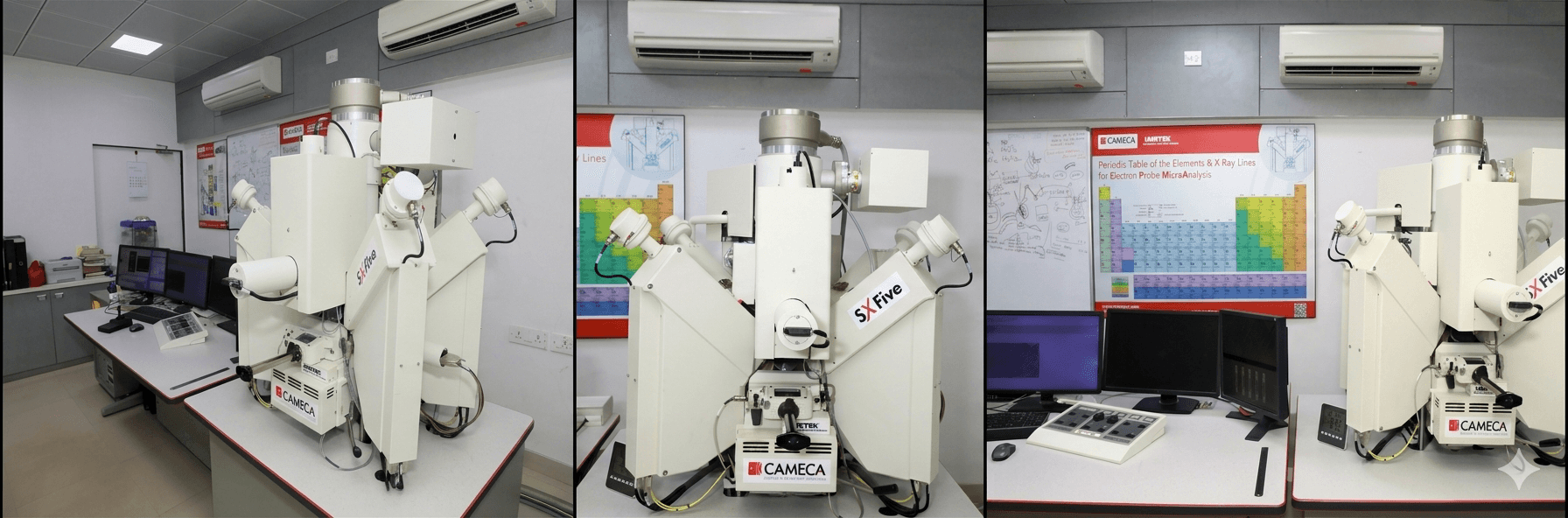
Electron Probe Micro Analyzer
DST- IITB National facility for EPMA
The EPMA lab is the national facility established in the Department of Earth Sciences funded by DST in 2013. This facility hosts an SX-5 from CAMECA (AMETEK), which is equipped with five WD spectrometers, a SE detector, a BSE detector, a CL detector and a microscope. An electron probe micro-analyzer (EPMA), also known as an electron microprobe, is a microbeam instrument used for non-destructive chemical analysis of small solid samples. It combines the features of a scanning electron microscope (SEM) with the ability to perform precise, quantitative elemental analyses at very small spot sizes (as small as 1-2 microns) primarily through wavelength-dispersive spectroscopy (WDS).The five WD spectrometers utilize various crystals, including LTAP, TAP, LLIF, LIF, LPET, PET, PC0, PC1, and PC3, enabling the analysis of a wide range of elements, typically from lithium (Li) to uranium (U), with detection limits in the parts per million range. Wavelength Dispersive Spectrometers (WDS) Provides high sensitivity and resolution for quantitative elemental analysis. EPMA enables in situ analysis of geological materials and detailed imaging, allowing for the examination of complex chemical variations within individual phases. It employs advanced electron optics for high-resolution imaging, surpassing what is possible with visible-light optics. Various imaging modes, including secondary-electron, backscattered-electron, and cathodoluminescence imaging, can be utilized, along with 2D X-ray element mapping and compositional analysis through WDS. The system is equipped with sophisticated software for data acquisition, processing, and visualization, making it easier to interpret results and generate reports. The CAMECA SX-5 is widely used in various fields including geology, materials science and semiconductors.
Contact Information
Prof. Prabhakar Naraga Email: prabhakarnaraga@iitb.ac.in